

What an interactive brand game is
An interactive brand game is a game built for a specific company, where the mechanics, art and rewards say something about it. Instead of watching a presentation, people play: they collect products, answer questions, climb a leaderboard or complete a mission to unlock a benefit.
At live activations, the game runs on touch screens, kiosks or tablets at the booth, with short rounds and a scoreboard visible to passers-by. In digital campaigns, it opens in the browser on phones or computers and can take many players at once. When the game becomes part of an internal event, such as a sales convention, we call it a corporate game.
Game formats we develop
| Format | How it works | Best for | Case |
|---|---|---|---|
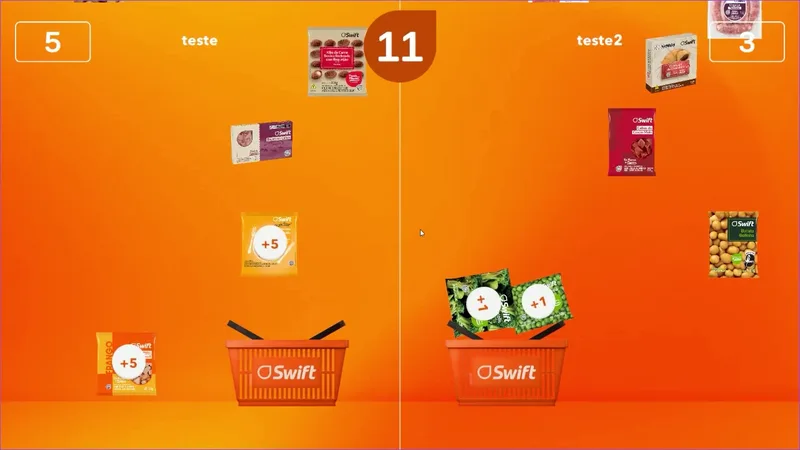
| On-screen duel | Two players side by side, with scores and a countdown; the brand's products are the game elements | Retail booths, trade shows and points of sale | Swift, with Pros (in Portuguese) |
| Skill game with leaderboard | Simple tap mechanics, a short round and each player's score at the end | Sports sponsorships and client relationships | B3 at the Rio Open, with Hands |
| Interactive quiz with giveaway | Questions about the theme, artist or brand; everyone who plays gets a giveaway | Concerts, festivals and VIP areas | Santander at the Alanis concert, with Bferraz |
| Personalized profile quiz | Answers produce a unique result for each person; with AI, the result is created on the spot | Job fairs, launches and data capture | Preparadão Santander and Jeep Avenger |
| Online gamified journey | A navigable world in the browser, with a map, interactions and progression | Digital campaigns, hybrid events and remote audiences | Google Black Friday |
| Reward mission | People explore, discover content and unlock discounts or benefits | Promotions, e-commerce and content partnerships | Claro + Citadel |
When a game calls for full immersion, it can move into virtual reality; when it calls for a whole brand universe, into an immersive website.
XR Studio game cases
Swift
Two people compete to put the most Swift products in their basket before time runs out. With the agency Pros (case in Portuguese).
See case ↗
B3 at the Rio Open
A tennis game for B3 clients: tap the yellow balls to score and see the results at the end. With Hands.
See case ↗
Santander at the Alanis concert
A trivia quiz about the singer in the VIP area, with an exclusive giveaway for everyone who played. With Bferraz.
See case ↗
Preparadão Santander
The Talent Oracle: five questions and a professional profile suggestion for each student. With Bferraz.
See case ↗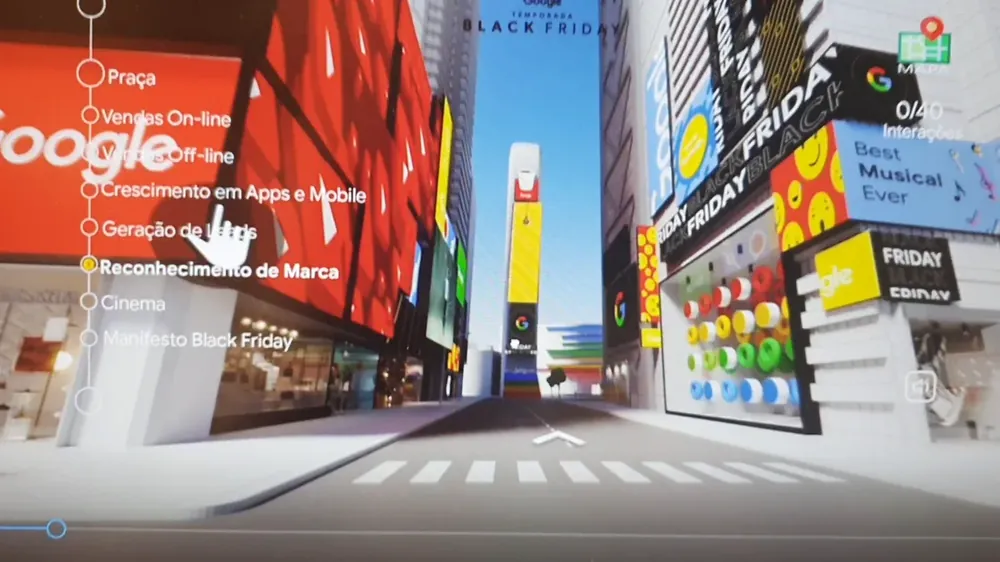
Google Black Friday
A virtual city in the browser, with a map, content and gamification to explore the Black Friday season.
See case ↗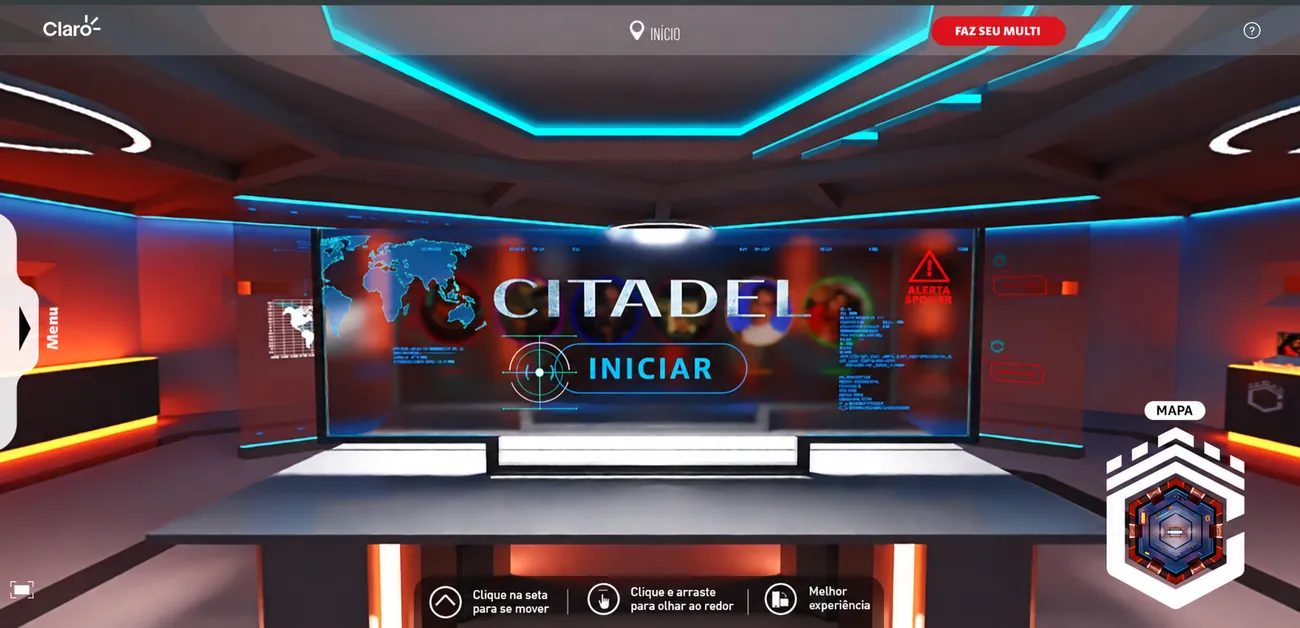
Claro + Citadel
A mission in the world of the Prime Video series: explore, discover and unlock discounts and benefits.
See case ↗Corporate event games: where to use them
The same principle works for brand events and internal events. The mechanics change with the goal:
| Event | Goal | Mechanics that tend to work |
|---|---|---|
| Sales convention | Engage the team and reinforce product messages | Product quiz with team leaderboard |
| B2B trade show and booth | Draw visitors and capture contacts | Short round with sign-up and a daily leaderboard |
| Festival and concert | Time with the brand and social media content | Duel or skill game on a big screen |
| Client relationships | Entertain guests in VIP areas | Themed quiz with giveaway or a scored game |
| Internal marketing and year-end | Team building and celebration | Competition between departments or a company quiz |
| Job fair | Guide and attract talent | Profile quiz with a personalized result |
| Onboarding and training | Make content stick through practice | Journey with levels; for high-risk tasks, VR training |
Event gamification: turning participation into memories
Gamification is the use of game elements, such as points, leaderboards, levels, challenges and rewards, in something that isn't a game. At a corporate event, it turns a passive booth visit, a talk or a convention into an experience where people act, compete and take something home.
Game mechanics that work at events
| Mechanic | What it drives | Where it appears |
|---|---|---|
| Points and scoreboard | Instant feedback: every action counts | B3 and Swift |
| Leaderboard | Friendly competition and the urge to try again | B3 at the Rio Open |
| Time limit | Pace, tension and short rounds that keep the line moving | Swift, with a countdown |
| Duel | An audience: onlookers cheer and learn the rules | Swift |
| Levels and missions | Progression and curiosity to keep going | Google Black Friday and Claro + Citadel |
| Reward | A reason to join and a reminder of the brand | Giveaway in the Santander quiz; discounts in Citadel |
| Personalized result | Exclusivity and something to show others | Preparadão and Jeep Avenger |
| Team challenge | Team building and collaboration at internal events | Conventions and internal marketing |
How gamification engages the audience
- The product takes center stage. In the Swift game, the packages are what players have to grab; the brand doesn't interrupt the experience, it is the experience.
- People waiting take part too. The round plays out on a screen in full view, so the line watches, cheers and learns the rules before playing.
- Leaderboards create competition. Scores, as in the B3 game, spark friendly rivalry and encourage another try.
- Simple rules include everyone. Mechanics people understand in seconds let all ages join in.
- Data with context. Sign-up before the round, the result and engagement time show who took part and how, always with consent.
Organic social media content
A well-designed game gives participants something they want to show. Three features amplify that effect:
- A shareable result. A card, photo or video with the result, delivered by QR code to the participant's phone. At the Jeep Avenger activation, the AI-generated superpower card went to the phone by QR code and was also printed; in the Leap Motor case, videos could be downloaded and shared on Instagram.
- A stage moment. A duel in full view, a leaderboard on the big screen and the winner's announcement become scenes people film and post.
- The brand in what gets posted. When the result art carries the brand's identity, every organic post takes the campaign beyond the event.
To measure that reach, add QR code visits and mentions of the brand's profile and hashtag to the game data.
From scratch: from concept to on-site operation
A generic game with a logo slapped on does little: the mechanics don't connect with the product and the art doesn't carry the identity. XR Studio develops custom games from scratch, with mechanics, art and rules created for each brand, and runs the activation on site with staff, hardware, a live leaderboard and reporting. The steps are in how we develop.
How we develop a game for your brand
- Briefing and goal. Audience, event, space and what the brand wants players to feel, learn or do.
- Mechanics and rules. We define the type of game, round length, scoring and reward.
- Art with the brand's identity. Products, characters, colors and tone become game elements.
- Development and testing. The game is tested on the event hardware, including without internet.
- Hardware and setup. Screens, kiosks, tablets and structure, with set design when the project calls for it.
- Live operation. Staff on site, an updated leaderboard and support throughout the event.
- Data and report. Participants, results and engagement delivered to marketing after the event.
Timeline: we recommend at least 4 to 6 weeks for a complete activation with game development. Simpler formats can be delivered in 2 to 3 weeks.
What drives the investment in an event game
| Factor | Smaller scope | Larger scope |
|---|---|---|
| Mechanics | Adapting a known format, such as a quiz | Original mechanics created for the brand |
| Art | 2D with the brand identity applied | 3D, characters and modeled products |
| Platform | One touch screen or tablet | Several stations, big screens or a browser game for many players |
| Players | One at a time | Duels or multiplayer |
| Integrations | Simple sign-up | CRM, AI, printing, QR code delivery and giveaway control |
| Operation | One day, one station | Several days, several cities, a larger team |
XR Studio quotes by scope after the briefing, including development, hardware, operation and reporting.
What to send in the briefing
- The goal of the activation and what the brand wants to measure.
- Event, date, city and expected number of visitors.
- Available space and whether there will be internet on site.
- Audience: age, profile and how much time they have to play.
- Reward: giveaway, discount, prize draw or just a leaderboard.
- Data the brand wants to capture and the legal basis under Brazil's LGPD.
- Brand guidelines, products and available materials.
Frequently asked questions
Who develops interactive games for brands in Brazil?
XR Studio, a creative technology studio based in São Carlos, Brazil, develops interactive games for brand activations and corporate events across the country, from concept to on-site operation. Its work includes the Swift duel with the agency Pros, B3's tennis game at the Rio Open with Hands, quizzes for Santander with Bferraz and Google's gamified Black Friday journey.
What is a corporate event game?
It's a game built for a specific brand or company and used at an event, such as a sales convention, trade show, festival or year-end party. The mechanics, art and rewards follow the event's goal: drawing visitors, engaging teams, reinforcing product messages or capturing data with consent.
What is event gamification?
It's the use of game elements, such as points, leaderboards, time limits, levels, challenges and rewards, in activations, booths, conventions and festivals. The audience stops just watching and starts acting, competing and taking a result home, which increases time spent with the brand and generates consent-based data.
How does gamification generate social media content?
By giving participants something they want to show: a card, photo or video with their result, sent by QR code, plus stage moments such as duels and leaderboards on a big screen. At the Jeep Avenger activation, for example, the AI-generated superpower card went to the participant's phone by QR code and was also printed.
How long does it take to develop a game for an event?
XR Studio recommends at least 4 to 6 weeks for a complete activation with game development. Simpler formats, such as adapting a quiz, can be delivered in 2 to 3 weeks.
How much does an interactive game for a brand activation cost?
The price depends on the mechanics (adapted or built from scratch), the art (2D, 3D, characters and products), the platform (touch screen, kiosk, tablet or the audience's phones), the number of simultaneous players, integrations (sign-up, CRM, AI, printing and giveaways) and the days of operation. XR Studio quotes by scope, after the briefing.
Does the game work without internet at the event?
Yes. XR Studio builds activations to run offline when needed. Internet is recommended for features such as sending results in real time and social media integration, and the team can bring its own 4G/5G router.
Can you capture participant data through the game?
Yes, always with consent. You can capture name, email, preferences, engagement time and game results. The data is delivered to the brand's marketing team after the event.
How many people can play at the same time?
It depends on the format. The Swift game is a duel between two people on the same screen; kiosk quizzes are usually individual; browser-based gamified journeys, like Google's, take many players at once, each on their own device.
Can the game carry my brand's identity?
Yes. The brand's colors, characters, tone and products can become game elements. In the Swift game, the brand's packages are the items participants have to collect in their basket.
Does XR Studio work on events outside São Paulo?
Yes. XR Studio works across Brazil and has run activations in cities such as Rio de Janeiro, Belo Horizonte, Brasília and Porto Alegre, bringing its team and equipment.
About this page. Written by the team at XR Studio, a creative technology studio based in São Carlos, Brazil, that has built interactive games, live marketing, immersive websites, AR and VR experiences and AI activations for brands since 2020. Each case mentioned has its own page with more detail. See also Live Marketing and AI Activations.